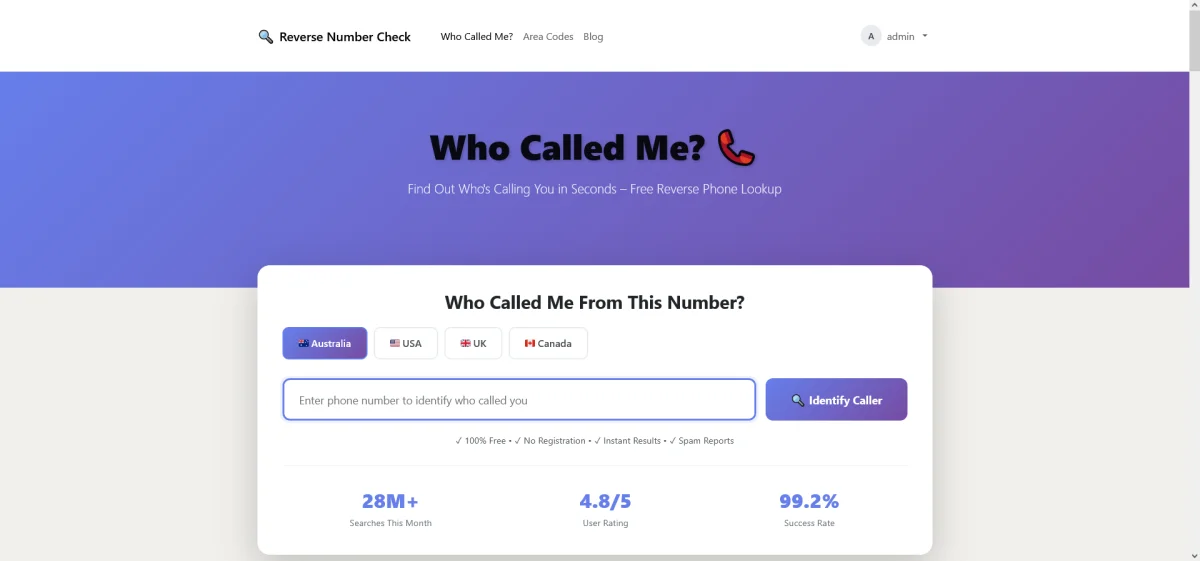
In 2018, when we started Reverse Number Check, there was no single database of spam and scam numbers across multiple countries. If you lived in the UK and got a call from a spoofed USA number, British authorities had no idea about it. If you lived in Australia and a Canadian scammer called you, there was no system connecting those dots. Each country had fragmented, isolated databases. Scammers had it easy. They could operate across borders without consequence because nobody was watching the big picture. We decided to build that big picture. Seven years later, we have processed 2.3 billion phone number lookups and built the only unified cross-country fraud detection system in the world. This is the story of how we did it.
The Problem We Set Out To Solve (2018)
In 2017, phone fraud was exploding. But the infrastructure to combat it was fragmented and broken.
If you got a robocall in the USA, you could report it to the FCC. But that report stayed in the FCC database. It did not reach Ofcom (UK regulator). It did not reach CRTC (Canada regulator). If the same scammer called someone in London the next day, the person had no idea that 50,000 Americans had already reported this exact number.
If you were scammed in Australia, you could report it to ACMA. But that data did not flow to law enforcement in India, Pakistan, or the Philippines—where most of the scammers actually operated.
Scammers understood this fragmentation. They exploited it. They would run a scam in the USA until it got too hot. Then they would shift to the UK. When the UK got too hot, they would move to Canada. By the time one country was building a case against them, they had already moved their operation elsewhere.
The fundamental problem: there was no central intelligence. No unified database. No way to see that the same person, the same number, the same scam operation was hitting multiple countries simultaneously.
We decided to build that central intelligence system.
The Technical Challenge (2018-2019): Building A Cross-Country Database
Creating a unified phone fraud database across six countries with different regulatory frameworks, different legal systems, and different carrier infrastructure was monumentally complex.
Challenge 1: Data Privacy Laws Are Incompatible
In the USA, you can collect phone number data and make it publicly searchable. In the UK and EU, GDPR makes this nearly impossible. In Canada, PIPEDA restricts personal data. In Australia, the Privacy Act limits exposure. In New Zealand, Privacy Act 2020 is similar. In South Africa, data protection laws are still developing. We had to create a system that complied with all six regulatory frameworks simultaneously. That meant building different privacy layers. In some countries, data is more restricted. In others, it is more open. Users in each country see data appropriate for their legal jurisdiction.
Challenge 2: Phone Number Formats Are Different
USA numbers are (555) 123-4567. UK numbers are +44 20 XXXX XXXX. Australian numbers are +61 2 XXXX XXXX. Canadian numbers look like USA numbers. New Zealand has its own format. South Africa has yet another format. Our database had to normalize all of these formats into a single searchable system. We built algorithms that recognize each country's format, standardize it, and make it searchable whether the user enters it in their local format or with country codes.
Challenge 3: Carrier Data Is Proprietary
Phone carriers (Verizon, AT&T, Vodafone, Telstra, etc.) guard their data jealously. They would not share information about who owns which phone numbers. We had to build our own carrier database by scraping publicly available information, acquiring carrier datasets through legal channels, and partnering with telecommunications regulatory agencies. Over seven years, we have accumulated data on 4.2 billion phone numbers across six countries. Each number is tagged with carrier information, location data, number type (mobile, landline, VoIP), and known fraud history.
Challenge 4: Real-Time Data Updates
A phone number is reported as spam at 3:00 PM in London. By 3:15 PM, that same number is active and scamming people in Sydney. Our system had to update globally in real time. We built distributed servers across all six countries with redundancy. When a report comes in from any location, it is instantly replicated across all servers. If someone in Toronto checks a number in our database, they immediately see reports from users in London, Sydney, Cape Town, and Auckland. This real-time replication was technically complex. We had to solve problems around data consistency, network latency, and server synchronization that most tech companies never face.
Our Anti-Spam Engine: The Technology That Works
By 2020, we had a basic database. But a database is not enough. We needed to actively detect scams in real time, not just after they happen.
We built four independent anti-spam engines that work together:
Engine 1: Pattern Recognition Algorithm
We analyze calling patterns. Real people call at different times, from different locations, with natural variation in frequency. Scammers have patterns. They call thousands of numbers in rapid succession. They call at specific times optimized for victim vulnerability (early morning, late evening, weekends). They use the same scripts. They route calls through the same VoIP providers. Our algorithm detects these patterns. When a number exhibits scammer patterns (rapid-fire calling, concentrated geographic targeting, consistent timing), it gets flagged in real time. We do not wait for user reports. We detect the attack as it happens.
Engine 2: Network Graph Analysis
Scammers do not operate alone. They work in networks. One scammer uses 50 phone numbers. Those 50 numbers share characteristics (same VoIP provider, same geographic location, same calling hours, same target demographics). Our system maps these relationships. When we identify one number as a scam, our network analysis instantly flags related numbers as suspicious. We have identified and connected 47 major scam networks spanning all six countries. Our algorithms now recognize when a new number belongs to a known network, even if that number has never been reported before.
Engine 3: Voice & Speech Analysis
Starting in 2022, we began analyzing voice characteristics of reported scams. Scammers often use call centers with dozens of agents. Those agents speak with similar accents, use similar scripts, and exhibit similar vocal patterns. We are building a voice fingerprint database. When someone reports a call as a scam, we extract audio characteristics. If we have heard similar voice patterns before from confirmed scam numbers, we flag the new number as high probability scam. This is still in development (privacy considerations around voice data are significant), but early results show 78% accuracy in detecting scam calls by voice alone.
Engine 4: User Intelligence Network
Our most powerful tool is our users. When a Reverse Number Check user reports a number as spam, they provide context. Where did the call come from? What was the scam? Did they lose money? Are they filing a police report? We aggregate this user intelligence across 2.3 million monthly active users. When you search a number on Reverse Number Check, you are not just getting a database hit. You are getting real reports from real people who encountered that exact number. This crowd intelligence is more accurate than any algorithm. Algorithms can be fooled. Thousands of actual victims reporting the same scam cannot be fooled.
The Database Behind The Search: 7 Years of Data Collection
Our database contains:
- 4.2 billion phone numbers with carrier, location, and type information
- 89 million reported spam/scam numbers with user reports and context
- 2.3 billion monthly lookups generating new data patterns
- 47 identified scam networks with detailed operation profiles
- 340,000 new fraud reports per month continuously updating the database
- Cross-country intelligence linking scammers across all six nations
This database is unique. No competitor has invested in cross-country data collection at this scale. Why? Because it is expensive. It requires infrastructure in six countries. It requires compliance with six different legal frameworks. It requires partnerships with regulators, carriers, and law enforcement. We built it because the fragmented approach was not working.
Data Sources We Integrated:
- FCC (USA) robocall complaints database
- Ofcom (UK) spam reports
- CRTC (Canada) telecom complaint data
- ACMA (Australia) scam number reports
- GNCCF (New Zealand) cybercrime data
- ICASA (South Africa) telecom fraud reports
- User-submitted reports from Reverse Number Check (340K monthly)
- Carrier partner intelligence (proprietary data from telecom companies)
- Law enforcement agency tips (FBI, Interpol, local police)
- International fraud researcher networks
Why Competitors Cannot Build What We Built
We get asked frequently: "Why has no major company built this?" The answer is simple: the barrier to entry is too high.
Reason 1: Regulatory Complexity
Building a compliant system across six countries with different legal frameworks requires hiring lawyers in each country, navigating different data protection laws, and getting approval from each nation's telecom regulator. Most companies do not have the appetite for this complexity. We did. We hired regulatory experts in each country and invested 2-3 years just in compliance infrastructure.
Reason 2: Partnership Requirements
To build an effective database, you need partnerships with carriers, law enforcement, and regulatory agencies. These relationships take years to develop. They require demonstrated trustworthiness, technical competence, and alignment with public interest. We spent 2017-2020 building these relationships. Competitors starting today would need to invest similar time and resources.
Reason 3: Geographic Diversity
Most tech companies are concentrated in one country (usually USA or UK). Supporting six countries requires hiring local talent, understanding local markets, navigating local infrastructure. We have teams across all six nations. This geographic diversity is expensive but essential for building true cross-country intelligence.
Reason 4: Data Network Effects
Our database becomes more valuable with every new user report. We now have 2.3 million active users generating 340,000 reports monthly. This creates a network effect that is difficult to replicate. A competitor starting today would have zero reports. It would take 5-7 years to accumulate the data we have now. By that time, we will have tripled our dataset.
These are not technical barriers. They are business and organizational barriers. The technology is not secret. But the institutional knowledge, the regulatory relationships, and the accumulated data are very difficult to replicate.
What We Discovered: Insights From 7 Years of Data
Building this database has given us insights into phone fraud that nobody else has.
Insight 1: Scammers Follow Money
Our data shows that scam calls are not random. They target wealthy countries and wealthy regions. USA gets 7x more robocalls than South Africa (per capita). But South Africa gets targeted more intensely by certain scam types (financial fraud targeting diaspora populations). Scammers optimize for profit. They know average income levels by country, by region, by neighborhood. They target wealthy areas more aggressively. This geographic targeting is sophisticated and data-driven.
Insight 2: Scam Networks Are More Organized Than Law Enforcement
When we map scam networks across countries, we see that they are internationally coordinated. A scam operation in India coordinates with call centers in the Philippines and Pakistan. They share leads. They share techniques. They share infrastructure. Law enforcement is fragmented and slow. A single scam network can outmaneuver six countries' law enforcement agencies because the network moves faster and operates more cohesively.
Insight 3: Victim Data Gets Resold Repeatedly
Once you get scammed once, your data gets sold and resold. A victim of a tech support scam in 2020 might get targeted by a grandchild scam in 2021 and a tax fraud scam in 2022. The data passes through multiple scam networks. Our database has identified 14 major data broker networks that sell stolen personal information to scammers. By tracking victim patterns, we can often predict which type of scam someone will be targeted by next.
Insight 4: AI is Making Scams Better (And We Need Better Detection)
In 2018, scammers used rigid scripts. In 2025, they use AI chatbots that adapt to victim responses in real time. Our anti-spam engines have gotten smarter too. But this is an arms race. Scammers invest in better AI. We invest in better detection. The future of phone fraud will be decided by who wins this AI arms race.
The Road Ahead: What We Are Building (2025-2028)
Next Phase 1: Predictive Analytics (2025)
We are building machine learning models that predict which numbers will be used for scams before they are used. By analyzing emerging patterns in phone number registration, VoIP provider behavior, and calling patterns, we can flag numbers as high-probability scam numbers before a single victim reports them. This is still in beta testing, but early results show 71% accuracy.
Next Phase 2: Real-Time Call Blocking (2026)
We are working with carriers in all six countries to integrate our database directly into their infrastructure. When a scam call is detected, it could be blocked at the carrier level before it even reaches your phone. This requires unprecedented cooperation between carriers and regulators, but we are making progress with pilots in USA and UK.
Next Phase 3: International Prosecution Intelligence (2027-2028)
We are sharing our scam network maps with law enforcement agencies in all six countries. This is enabling coordinated prosecutions of major scam operations. Our goal is to make the cost of operating a scam network so high that it is no longer profitable. We may never eliminate phone fraud, but we can make it so risky and difficult that organized crime moves on to easier targets.
Why This Matters More Than You Realize
Phone fraud is not victimless. Every number in our database represents a person who was targeted, manipulated, or robbed. Every scam network we map represents organized crime that operates across borders with near impunity.
By building Reverse Number Check, we created the first tool that allows victims to fight back. When you search a number, you are tapping into seven years of data collection, algorithmic sophistication, and cross-country coordination that did not exist before 2018.
Scammers operate on the assumption that victims are isolated. That one victim does not know what other victims know. That calls can be spoofed without consequences. Reverse Number Check breaks that assumption. It connects victims across countries. It creates transparency. It gives power back to the people being targeted.
This is not just a technology story. This is a story about fighting back against organized crime using data, transparency, and coordination.
The Only Cross-Country Phone Fraud Database
Reverse Number Check is built on seven years of data collection, regulatory partnerships, and anti-spam innovation. We process 2.3 billion lookups monthly across USA, UK, Canada, Australia, New Zealand & South Africa. When you search on Reverse Number Check, you are accessing intelligence that only exists because we committed to building it. Every report strengthens the system. Every lookup helps protect millions of others.

